
Welded TPO
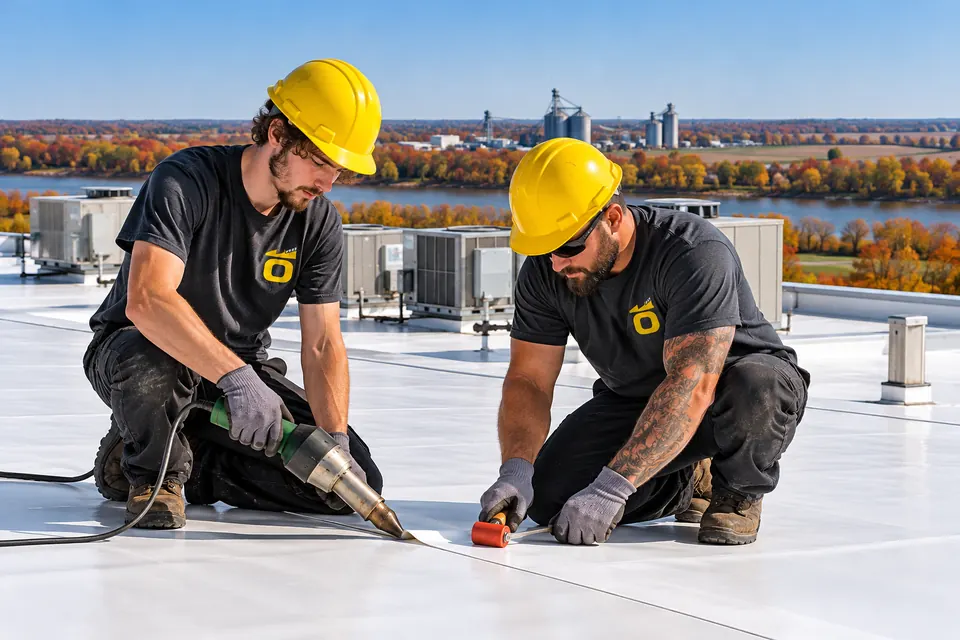
Hot-air welded TPO seams need a dry sheet but no tape or adhesive at the laps, which helps on damp-prone sites.
As a Calhoun commercial roofing contractor, we install and repair membrane and metal roofs in the McLean County seat, timing seam and adhesive work around damp mornings.
A Calhoun commercial roofing contractor plans around the river. Calhoun sits along the Green River’s north bank, and damp river mornings can delay adhesive and sealant work, since membranes have to be dry before seams, flashings, or bonding adhesive go down.
Permit questions go to the McLean County local building inspector, and Calhoun City Hall covers city rules. These moisture checks happen on every Calhoun visit, whatever the roof type.
Moisture shapes most roof problems on buildings near the river.
Adhesive or tape laid over a damp surface never stuck across the full width of the lap.
Laps are opened, dried, cleaned, primed, and resealed in dry conditions, then rolled along their length.
Wind-blown silt and debris settle in strainers and gutters and slow every storm’s runoff.
Drains and gutters are cleared and strainers replaced before any new roof is tied in to them.
Water held in wet insulation sat against the steel deck long enough to rust it.
Core cuts near past leaks check the deck, and rusted sections are replaced during tear-off.
Moisture trapped under the sheet at install time expands on hot afternoons and lifts it.
Blisters are cut, dried, and patched, and the cause is checked before more of the roof is opened.
Waiting an hour for a dry surface protects every seam laid that day.
Tape and adhesive on a wet sheet hold at first, then release as the moisture works out.
Starting after the dew burns off gives each seam a dry surface to bond across.
Uncovered board stacks pick up overnight moisture and carry it into the new roof.
Covered stacks stay dry, so only dry boards go under the membrane.
A new membrane draining into a mud-packed outlet ponds from its first rain.
Clearing drains first means the new roof drains the way it was designed.
Rust left in place keeps weakening the deck under fresh insulation.
Replacing rusted deck during tear-off gives the new assembly a firm base.
Three roof types cover most Calhoun shops, offices, and storage buildings.
Hot-air welded TPO seams need a dry sheet but no tape or adhesive at the laps, which helps on damp-prone sites.
Pitched shops and storage buildings take standing seam or R-panel, with gutters and valleys kept clear of river silt and leaves.
Released laps and blisters on an otherwise dry roof can be handled as repairs on a dry afternoon.
Early seam failures often trace back to damp install conditions. Call and describe the roof, and we will check the laps and the insulation under them.
Each day on a Calhoun roof follows the same routine.
Seams, blisters, drains, and the deck near past leaks are checked, with core cuts where moisture might be trapped.
Mud and debris come out of drains and gutters, and strainers are replaced so tie-ins drain cleanly.
Seam, flashing, and adhesive work starts after dew is off the deck, insulation, and membrane.
Only the area that can be finished that day is opened, and rusted deck is replaced as soon as it is exposed.
Each finished section is sealed with a tie-in, and stacked insulation is covered before the crew leaves.
Calhoun and the towns below make up our commercial roofing area on this side of the river. Need roof work elsewhere? Simply call us or send us a message.
Calhoun, the McLean County seat, sits along the Green River’s north bank, and damp river mornings can delay adhesive and sealant work. Membranes must be dry before seams, flashings, or bonding adhesive go down.
Crews plan later starts, cover insulation overnight, clear drains before tie-ins, and check the deck near past leaks.
The McLean County local building inspector reviews permit questions, and Calhoun City Hall covers any city rules. Raise recover layers, drain changes, and deck replacement early in the conversation.
Dew on the deck, insulation, and membrane keeps tape and adhesive from bonding across the full lap. Waiting until surfaces dry protects every seam laid that day.
TPO seams are fused with hot air rather than tape or adhesive at the laps, so the seam itself needs no bonding agent. The sheet still has to be dry, and adhered systems still need dry boards.
At least each spring and fall, plus after big storms. Silt and leaves settle in strainers and gutters, and a clogged outlet turns the next heavy rain into ponding on the roof.
Panel installation itself handles damp mornings better than adhesive work, since clips and screws hold the steel. Sealant at laps, trim, and curb flashing still waits for dry surfaces, so the day is planned with panels first and sealing later.
Each section is opened only when the forecast allows it to be finished and tied in that day. Crews watch hourly rain chances, keep tarps and tie-in materials on the roof, and close the open edge before a storm reaches the building.
Tell us the building, the roof type, and where water gets in. We will plan the work around the weather and send a free estimate.
Want a call back about your roof?
Leave a name and number and we will call you, or call (270) 249-4493 now.