
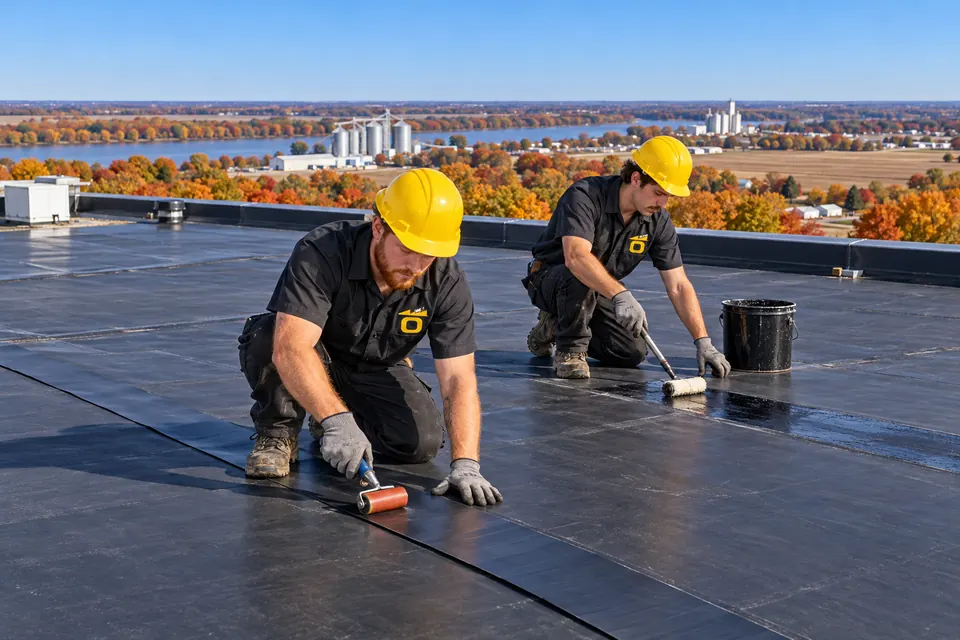
Section Repair
- Fits When
- Leaks trace to a few seams or flashings
- Core Cuts
- Insulation dry around the leak
- Materials
- Same membrane or panel profile
- On Site
- Small crew, hand-carried materials
- Next Step
- Dated photos for the roof file

As an Owensboro commercial roof repair contractor, we trace each leak to the failed seam, drain, or flashing and repair it with matching membrane or panels.
An Owensboro commercial roof repair contractor sorts each leak into one of these two answers, based on how much of the roof is still dry.
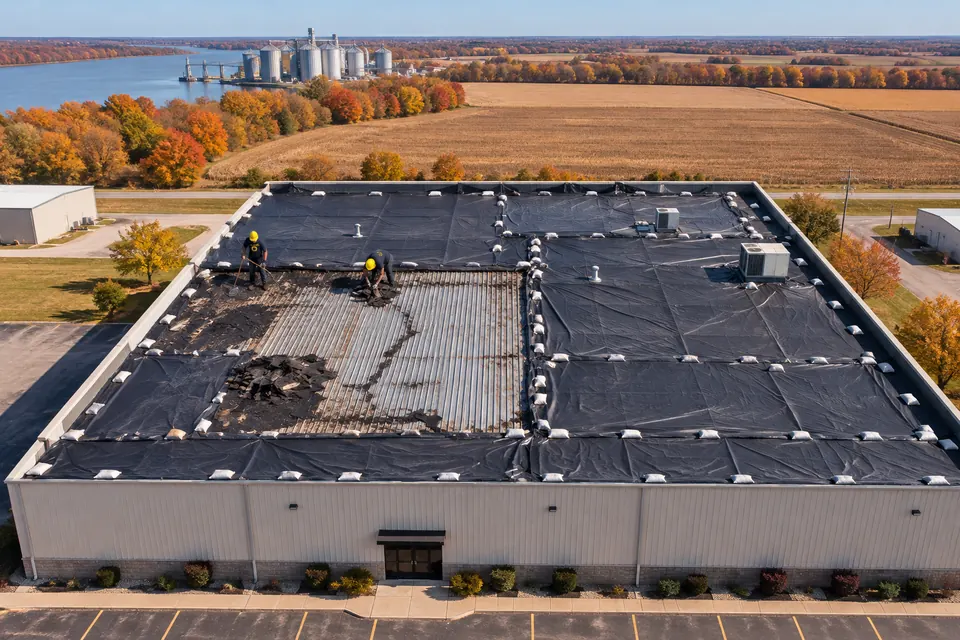
When the answer is replacement, the system choice moves to TPO, EPDM, or metal panels.
These five leaks make up most repair calls, and each one has a usual source on the roof.
Loose clamping rings or a cracked drain bowl let water slip under the membrane right at the outlet.
We reset or replace the clamping ring and strainer, then weld or tape a target patch around the drain.
Curb flashing splits at the corners, and old pitch pans dry out and pull away from pipes.
Corners get reflashed with the membrane maker’s parts, and pitch pans are swapped for boots that fit the pipe.
Moisture or air trapped between layers expands in summer heat and lifts the sheet into blisters.
Blisters are cut, dried, and patched, and a core cut nearby shows whether the boards underneath are wet.
Coping joints open up and counterflashing works loose, so rain gets behind the wall flashing.
Counterflashing is refastened, coping joints resealed, and the wall flashing terminated under the cap again.
Perimeter edge metal and open laps near corners catch rain that blows sideways under them.
Edge metal is refastened at a tighter spacing and the laps along the perimeter are cleaned and resealed.
Repairs are matched to the roof that is already there, so the patch and the old sheet bond or weld as one.
Open TPO and PVC seams are cleaned and rewelded with hot air; EPDM laps get primer, new seam tape, and lap sealant at the cut edges.
Curbs, pipe boots, skylight frames, and wall flashing are reflashed with matching material so the repair turns up and seals at full height.
Clamping rings, strainers, and scupper linings are reset or replaced, and clogged outlets are cleared before any patch goes down.
Backed-out screws give way to larger ones with new washers, and open side or end laps get butyl tape and stitch screws.
A small leak left alone spreads through the assembly. Fixing it early keeps the damage to one spot.
Each rain pushes water farther along the deck and soaks more boards around the original leak.
Sealing the entry point keeps the wet area small enough to cut out and replace during the repair.
Wet boards hold water against the deck flutes until the steel softens and needs replacing.
Dry boards and a sealed membrane stop the rust before deck sections have to be cut out.
Drips land on racking, equipment, and ceiling tile long before the roof itself looks bad.
Stopping the drip protects what sits under the roof while a longer plan is worked out.
Water in a small gap freezes on cold nights, expands, and pries the lap open a little more.
A welded or taped repair closes the gap before freeze-thaw cycles can widen it.
Call and tell us which drain or which bay. Drain leaks often trace to a loose clamping ring that is quick to find on the first visit.
Five steps, in order, from the stain inside to the dry roof above it.
The whole roof gets walked, not only the leak area, because a second weak seam or a clogged drain nearby will cause the next call.
Interior stains are matched to roof locations, then seams are probed and flashings checked uphill of the stain, since water travels along the deck.
Core cuts show whether the insulation around the leak is dry. Wet boards are cut out and replaced before the membrane is closed.
TPO is welded to TPO, EPDM is taped to EPDM, and metal panels are swapped for the same profile and gauge.
Welded seams are probed, drains are run with water where safe, and dated photos of each repair go into your roof file.
If the roof walk finds more wet area than dry, these are the next pages to read.
Ponding behind units and around drains usually needs tapered insulation or new outlets, which a patch cannot add.
Large low-slope roofs with failing seams across the field often move to a new welded white membrane.
Rust holes across many panels or sagging purlins call for framing repair and new panels on the whole slope.
By working backward from the stain. Water enters at a seam, flashing, or drain and then runs along the deck, so the drip inside is often several feet downhill from the opening.
We mark the stain by bay or column line, walk the roof above it, probe seams, check curbs and drains uphill, and use core cuts to see how far the water spread.
Yes, when the rest of the roof is dry. Many owners repair the worst section now and plan replacement of the remaining roof for a later budget year. Dated photos from each visit show whether the waiting sections are holding or starting to slip.
The price follows what the roof walk finds: how many leak points, whether insulation underneath is wet, the membrane or panel type, and how hard the area is to reach. A single drain reset costs far less than cutting out wet boards around a curb. The free estimate lists each repair separately.
Both. Metal roof repairs cover backed-out screws, dried washers, open laps, rusted panels, and loose curb or wall flashing. Membrane repairs cover TPO, PVC, and EPDM seams, blisters, and flashings. Details for steel roofs are on the metal roofing page.
Often, with the right products. Cold-weather adhesives and primers exist for EPDM, and TPO welds well when the surface is dry and test welds pass. Frost, dew, and snow on the membrane are the real limits, so winter repairs wait for a dry afternoon.
Tell us where the water shows up inside and when it started. We will walk the roof and give you a free estimate for the repair.
Want a call back about your roof?
Leave a name and number and we will call you, or call (270) 249-4493 now.