
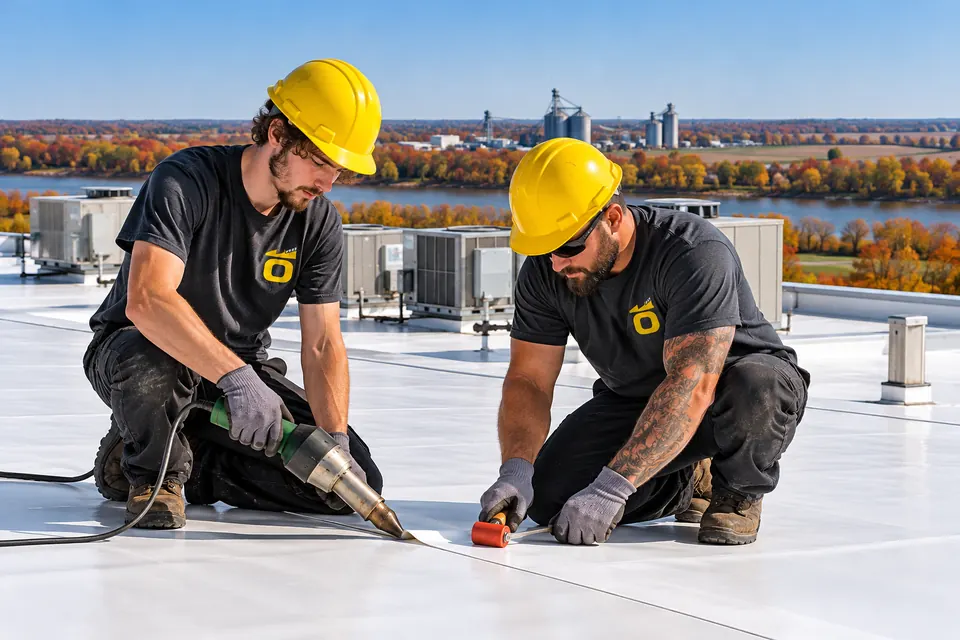
PVC Or KEE-Blend Sheet
- Best Near
- Kitchen exhaust and oil mist
- Grease And Oil
- Strong resistance
- Seams
- Hot-air welded
- Field Use
- Zones around fans and vents
- Check First
- Chemical list from the plant
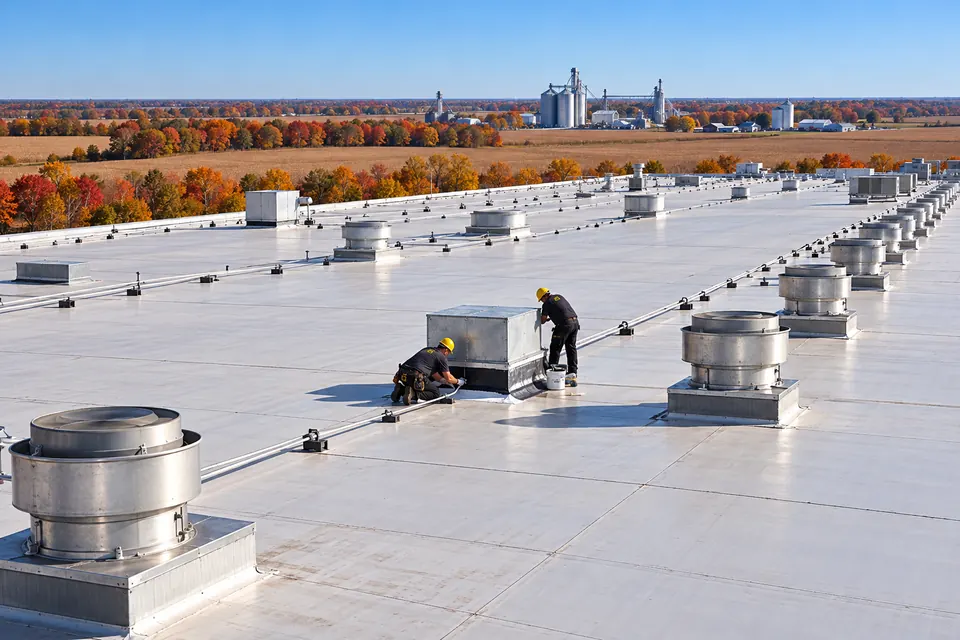
As an Owensboro industrial roofing contractor, we match membranes to plant exposures and replace roofs in sections so production keeps running underneath.
An Owensboro industrial roofing contractor checks the membrane maker’s chemical resistance chart against what actually lands on the roof.
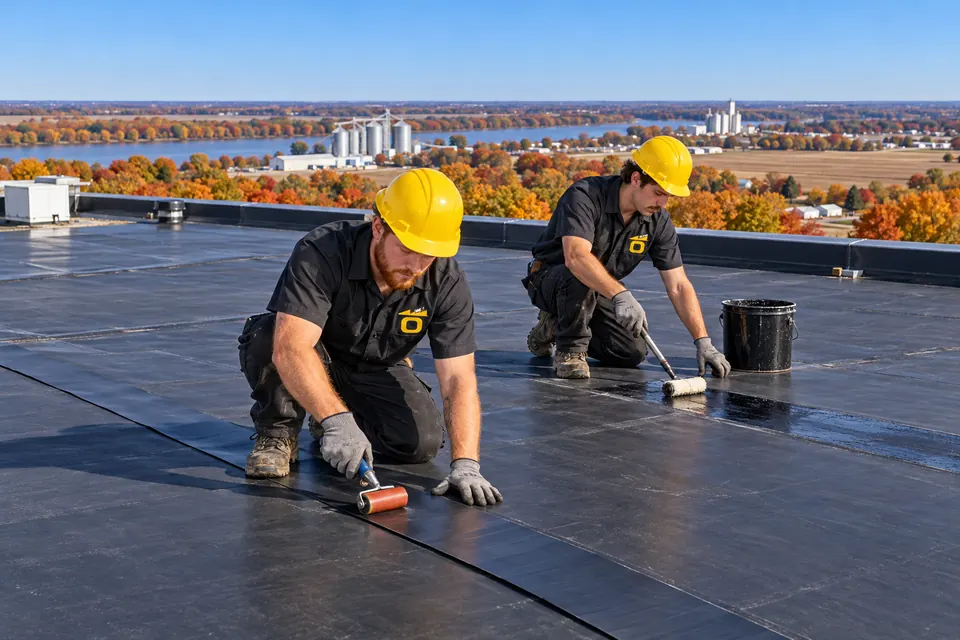
Many plant roofs use both: a resistant sheet around the exhaust zone and a standard membrane across the rest of the field.
Plant roofs carry more equipment and harsher exposure than most commercial roofs. Wear shows up in these places.
Oil or chemical residue from process vents attacks sheets that are not rated for it.
We sample the area, check the maker’s resistance chart, and replace that zone with a matched sheet.
Heat from ovens, kilns, or stacks bakes the membrane and flashing nearest the source.
Metal or heat-rated flashing details go in around hot penetrations, with clearance kept to the sheet.
Maintenance crews walk the same line to units, fans, and dust collectors every week.
Walkway pads mark the path from the hatch to each service panel and take the wear instead.
Pipes and racks resting straight on the sheet rub through it as they expand and contract.
Pipes go onto raised supports with pads beneath, so the membrane passes freely under them.
Large roof areas send runoff to a few drains that collect dust, grit, and debris from the process.
Drains are cleared, strainers replaced, and outlets added where one drain serves too much area.
Each condition on a plant roof points to a specific membrane, thickness, or detail.
PVC or KEE-blend sheets around exhaust fans and oil-mist vents, with sacrificial walkway pads and grease traps protecting the field.
Metal or heat-rated flashing at stacks and kiln vents, where a standard membrane would bake and crack near the heat source.
Thicker sheets and walkway pads along maintenance routes, sized for the crews and carts that cross the roof every week.
Raised pipe supports, curbs tall enough to flash after new insulation goes down, and boots in place of old pitch pans.
A plant roof built for its exposure stops the failures that general-purpose roofs keep repeating.
Grease and oil soften standard sheets until seams near the fans open again after each repair.
A sheet matched to the plant’s chemical list holds up in the exposure zone.
Warm, humid plant air meets a cold deck in winter and rains back down on equipment.
Insulation over the deck, with a vapor retarder where humidity runs high, keeps the deck underside warmer.
Opening a large roof at once puts equipment and stock under open deck if weather turns.
Sections opened and closed in one shift keep each area under the work dry.
Curbs that end up too short after new insulation leave flashing with nowhere to turn up.
Curbs are raised, pipes put on supports, and every penetration flashed with the maker’s parts.
Call and tell us which fans and what the plant runs. Grease on a standard sheet tends to open seams fast, so that zone gets looked at first.
Replacement on an industrial roof is planned with the plant team before the first section opens.
Residue near vents, heat at stacks, traffic paths, pipe racks, and drain sizes are recorded, along with core cuts across the field.
Roof areas over sensitive equipment, finished product, or clean processes are marked so they are opened only in dry weather windows.
Rooftop units and exhaust fans are scheduled off by zone, intakes are protected from dust and adhesive odors, and hot-work permits cover any torch work.
Crane picks, material staging, chutes, and dumpsters sit outside forklift lanes and away from loading docks.
Crews remove only what they can cover with new roof that shift, and each section is sealed with a tie-in before they leave.
Industrial sites often mix roof types across wings and outbuildings.
Warehouse wings away from exhaust zones often take welded white TPO across the open field.
Pitched maintenance shops and storage sheds on plant property usually carry standing seam or R-panel.
Punctures from dropped parts and split curb flashing get repaired between full replacements.
Heavier equipment, more penetrations, and harsher exposure. Stacks, process vents, conveyors, and dust collectors pass through or sit on the roof.
Chemical residue, heat under the deck, maintenance traffic, pipe racks, and large drains each point to a membrane type, a thicker sheet, pads, or raised supports. Plant safety rules shape roof access too.
The one rated for that exposure on the maker’s chemical resistance chart. Oil mist and grease usually call for PVC or a KEE-blend sheet, light dust and runoff suit TPO or EPDM, high heat near stacks calls for metal or a heat-rated detail, and solvent vapor needs a sheet matched to the chemical list.
In sections, so each area under the work stays dry. Crews map roof areas over sensitive equipment, schedule unit and fan shutdowns by zone, protect intakes from dust and odors, and stage cranes and dumpsters outside traffic lanes, then seal every section with a tie-in at the end of each workday.
Curbs are raised where new insulation makes them too short, pipes are set on supports with pads, walkway pads run to each unit’s service panel, and pitch pans are sealed or replaced with boots. The plant’s mechanical contractor handles disconnects and reconnects, and the roofing crew flashes around the finished equipment.
The required R-value comes from the code tables for the building’s climate zone and roof type. The U.S. Department of Energy lists Kentucky’s commercial code as the 2012 IECC and ASHRAE 90.1-2010, and the local building inspector confirms which rules apply to a given replacement.
Share what the plant runs, where the exhaust fans sit, and which areas cannot get wet. We will walk the roof and plan the work in sections.
Want a call back about your roof?
Leave a name and number and we will call you, or call (270) 249-4493 now.