
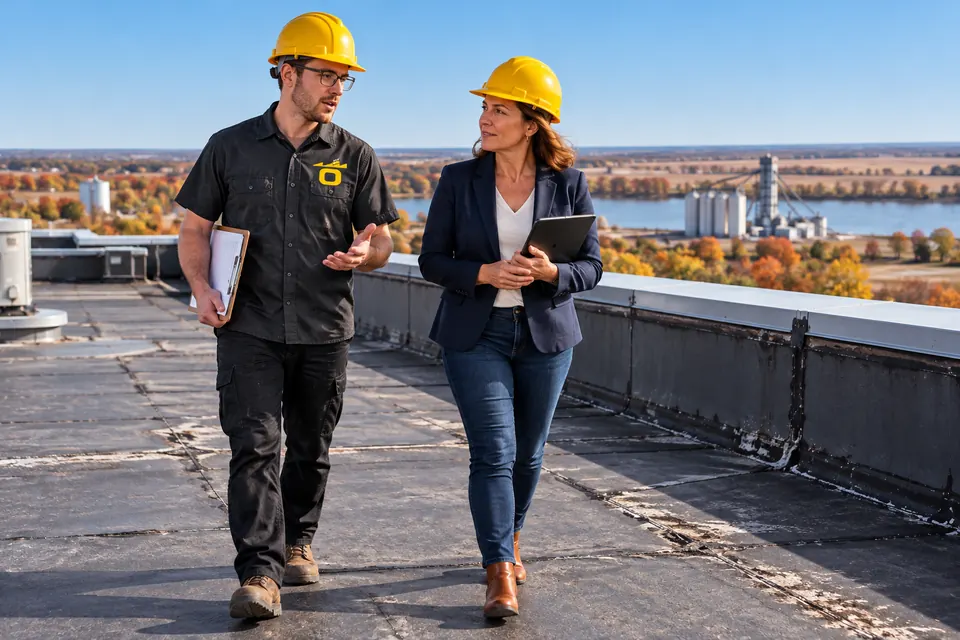
Ballasted EPDM
- Holds By
- River stone or pavers over the sheet
- Deck Load
- Framing must carry the stone
- Edges
- Parapet or gravel stop holds ballast
- Wind Watch
- Scour at corners
- Around Units
- Stone moved for every repair
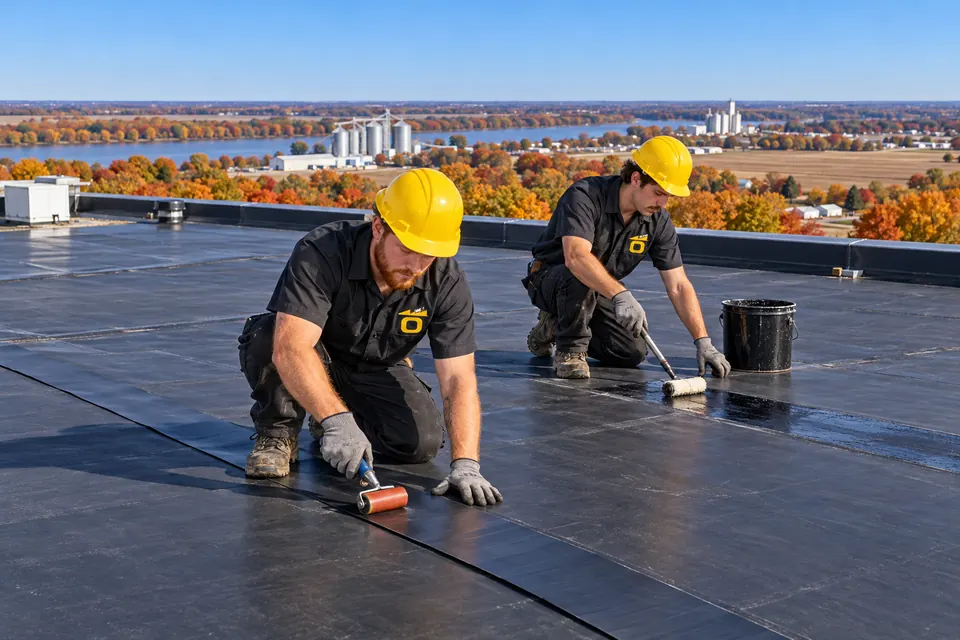
As an Owensboro EPDM roofing contractor, we install rubber membranes on warehouses, factories, schools, churches, and strip centers, including recovers over dry roofs.
Your Owensboro EPDM roofing contractor picks the attachment from deck strength, roof height, and wind exposure. These are the two most common answers.
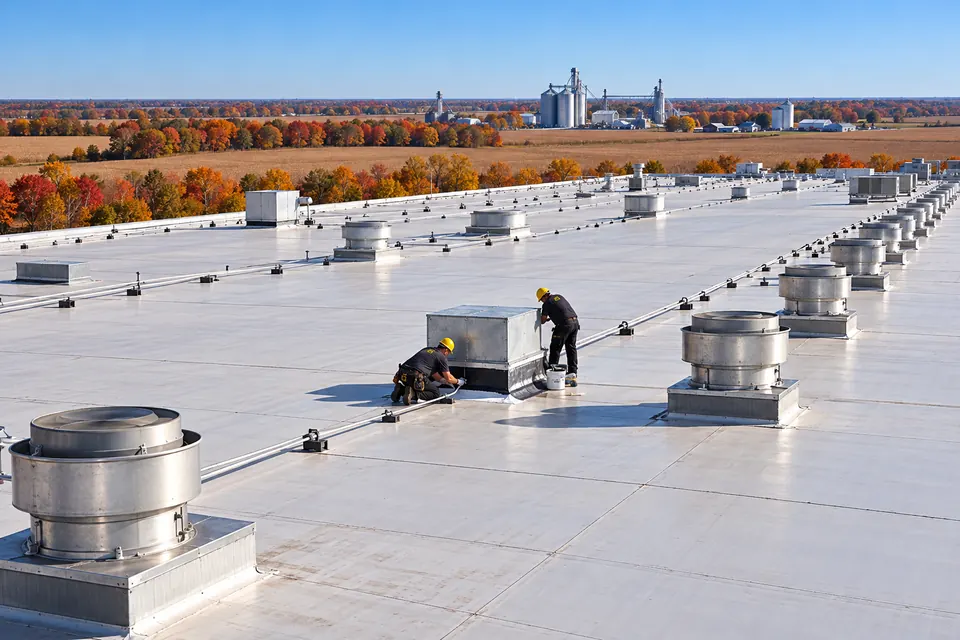
A third option, mechanically attached EPDM, holds the sheet with plates and fasteners in the seams and is watched for flutter in high winds.
Rubber roofs wear out at the seams and edges long before the field sheet itself gives up.
Laps that were not cleaned and primed well let the tape release a little more each season.
We clean back to bare rubber, prime, apply new seam tape, roll it firmly, and seal the cut edges.
Aging EPDM shrinks across the field and tugs the wall flashing until it bridges the corner.
Bridged corners get new uncured flashing; widespread shrinkage points to a recover or new sheet.
Wind scours river stone from the corners of ballasted roofs and leaves the sheet exposed to sun.
Stone is redistributed or swapped for pavers at corners, and any damaged rubber gets patched first.
Dropped screws and tools puncture the sheet wherever service work happens most.
Punctures get primed patches with taped edges, and walkway pads go in along the service path.
Field-cut flashings and caulk around round pipes split as the rubber ages and moves.
Round penetrations get pipe boots made for EPDM, sealed to the field with tape and lap sealant.
Color, attachment, and whether the old roof stays all change the final assembly.
The standard rubber sheet absorbs sunlight and keeps more heat in the roof surface, which owners of heated warehouses with little cooling often prefer.
A white top layer over black rubber gives a lighter surface for cooled offices and retail while keeping the cold-weather flexibility of EPDM.
Over a dry, firmly attached flat roof, a cover board and new rubber sheet go on top once wet areas are cut out and drains are reset to the new height.
Each item pairs a common failure on an older flat roof with what a new rubber sheet changes.
Narrow sheets and old roll roofing leave many seams, and each one is a place for water to start.
Large EPDM sheets cover open areas with very few field seams to tape and maintain.
Brittle membranes split when temperatures drop and the building contracts under them.
EPDM stays flexible in cold weather, so the sheet moves with the building instead of cracking.
Field-cut metal and mastic details around units dry out and open up first on most flat roofs.
Uncured EPDM flashing stretches around curbs and corners, and pipe boots fit round penetrations.
Removing a dry, solid roof adds debris, labor, and open-deck risk when the old roof could stay.
A recover over a dry roof, with a cover board between, saves the tear-off where the code and layer count allow it.
Lifted tape at laps and T-joints lets water under the sheet a little farther each rain. Point us to the worst spot and we will check the rest.
Rubber roofs go on in this order, with surface prep deciding how well every seam holds.
Core cuts or a moisture survey find wet areas, and blisters and loose seams in the old roof are noted before any recover is priced.
Dry, firmly attached roofs within the layer limits can take a recover; wet sections get cut out, and the local building inspector confirms the rules.
Ballast needs a deck and framing that carry the stone; adhered sheets need cure weather; fastened sheets need extra plates at the edges.
Both sheets are cleaned, primed, and allowed to flash off, then tape goes down, the upper sheet is pressed on, and the seam is rolled along its full length.
Uncured flashing wraps curbs and corners, pipe boots go on round penetrations, and lap sealant covers cut edges and T-joints.
These services often come up on the same building as a rubber roof.
Cooled offices and retail wings next to a black rubber warehouse roof often get welded white TPO instead.
Ponded areas found during a recover get tapered insulation or crickets before the new sheet is laid.
Existing rubber roofs with a few failed laps or punctures can be patched and taped instead of replaced.
EPDM is a synthetic rubber membrane, most often black, that stays flexible in cold weather and comes in large sheets with few seams. It covers low-slope warehouses, factories, schools, churches, and older strip centers across western Kentucky.
It fits roofs with few rooftop units and little grease, and large open areas where big sheets cut the seam count.
With primer and seam tape, pressed together and rolled so the tape bonds across its full width. Rubber has no heat welding, so prep decides how well a seam holds: clean both sheets, prime and let it flash off, lay the tape, press the upper sheet on, roll it, and seal cut edges and T-joints.
That depends on deck strength, roof height, wind exposure, and how much weight the structure carries. Ballast needs framing for the stone and a parapet or gravel stop. Adhered systems give the cleanest look at units and hatches. Mechanically attached sheets use plates in the seams and are watched for flutter.
Only when the existing roof is dry, firmly attached, and within the code’s recover layer limits. Wet insulation is found with core cuts and replaced, blisters and loose seams are cut and flattened, drains are reset to the new height, and a cover board gives the new rubber a smooth base.
Follow how the building is used. Cooled offices, retail, and plants with heavy internal heat fit white; heated warehouses with little cooling fit black; unconditioned storage can take either. Insulation thickness under the sheet affects energy use more than the color does.
Tell us whether the roof has stone on it, how many layers you think are there, and where it leaks. We will inspect and price the rubber roof.
Want a call back about your roof?
Leave a name and number and we will call you, or call (270) 249-4493 now.